Adapters for alternative lenses
Why?
There are many reasons why to use alternative lenses. Some use them because
they have them from their old system. Some use for cheap price. And some use
because of special characteristics alternative lenses can offer. Also some lenses
offer quality that cannot be found from Canon lenses, e.g. Leica Summicron 90/2.0
APO and Carl Zeiss Distagon wide angles.
I use alternative lenses mainly for the characteristics and Canon's lack of
capability to buid good wide angle lenses (I don't even need ultrawide...). Some
of the Canon lenses have some characteristics, for example
Canon EF85 f/1.2L USM Mark II or Canon EF135
f/2.0 L USM. However even these very fine Canon lenses lack some
characteristics which I prefer, like good micro-contrast over whole frame or
lack of chromatic aberrations, specially in areas outside depth of field where
for example otherwise excellent Canon 85L really sucks with the pink fringe.
How it's possible
Canon EOS system has one of the shortest distances from lens mount to the
film/sensor. Therefore it's possible to create adapters which will come between
the lens and Canon EOS camera body. There are no optical elements, and the picture
quality is as good as it is with the original camera into which the lens was
designed for.
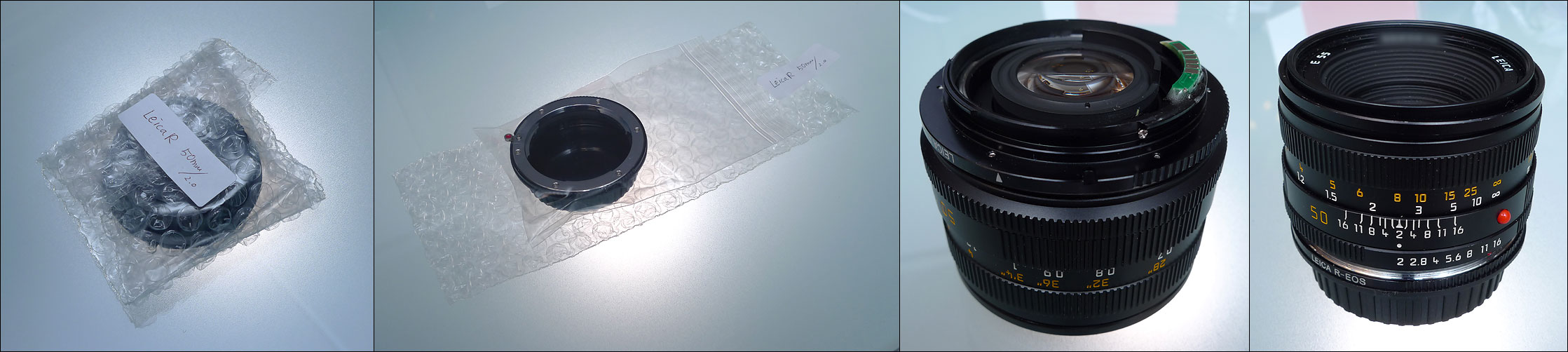
I have adapters for Nikon F mount, Contax/Yashica mount and Leica R mount. Below are
pictures of them and they are in same order which I listed them:
There are adapters for other systems as well, like Olympus and M42.
Some lenses cannot be used in Canon EOS even there is adapter available. Reasons
can be protruding things to mirror chamber and lens not having manual control for
aperture (e.g. Nikon 14-24mm which many people would like to use in fullframe
Canons).
How adapters are used
Since there is no electronical connection between lens autofocus and automatic
stopping down of lens is lost. Therefore alternative lenses are not for mainstream.
Also due to implementation of exposure metering of non-professional cameras exposure
is not metered correctly when lenses are stopped down. I have listed below two
procedures how I have used the lens.
Procedure with non-professional camera (20D, 40D, 5D etc.):
1. Set camera to M-mode
2. With lens wide open manual focus and measure exposure
3. Close down the lens to aperture you want to use
4. Calculate exposure at closed aperture from wide open measurement
5. Take photo
Procedure with professional camera (1D series):
1. Set camera to Av
2. With lens wide open manually focus
3. Close down the lens to aperture you want to use
4. Take photo
Adapter quality
Adapters can have many kind of quality problems. At least following can be
problematic:
- adapter flatness (may result for example left side being less sharp than right
side)
- adapter flare (better adapters are painted back from the part which is exposed
to camera sensor)
- bad tolerances (adapter may not fit or is too loose to lens)
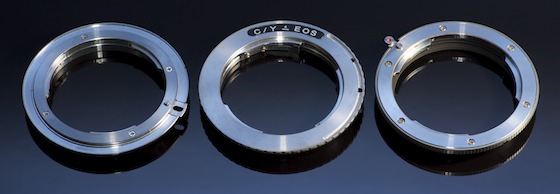
Fotodiox C/Y adapter bad quality
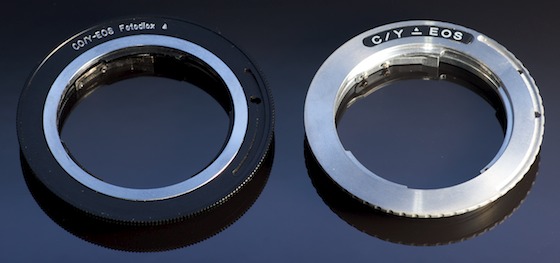
Even photodiox is supposed to be best of the adapters I wasn't very happy to their
product. There was some play between the adapter and the lens. When lens was attached
to adapter and adapter to camera I can move the lens about 0.5mm to up, down, left or
right (in same plane as lens mount). Therefore I ordered cheap eBay adapter but
problem with it was too thick and lenses could not focus to infinity. Therefore I
needed to adjust the focus of my only C/Y lens Carl Zeiss
Distagon T* 28mm f/2.8 to match the adapter.
2009-01-05 New adapters
I decided to change all my adapters to "happypagehk" adapters. Now my most used lenses
have EXIF chip which is coded according to lens focal length and maximum aperture.
I did take some photos with adapters and they seem to be working very well. When there
was EXIF chip in the adapter it seems that exposure is metered more accurately.
Happypage adapters seem to be perfect in every way:
- right thickness; now my Leicas focus to infinity and Contax past infinity (I adjusted it to
be used with too thick adapter)
- all (I did buy one C/Y, 2 Leica R and 2 Nikon F adapters) do have stop skrew
- side visible to mirror box is anodized to black
- mechanically better than any of my previous adapters
Adapters got to Finland pretty fast, specially considering that each adapter's chip
had to be flashed to lens specific values. I made the order at 4PM GMT +2 31st December
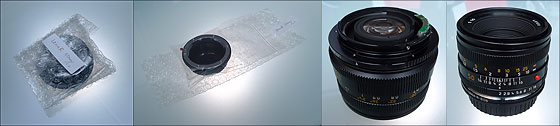
2008 and got the adapters this morning (5th Jan - New Year and weekend in between). Packaging
was pretty good as can be seen in photo below and each adapter included lens back cap.
Here is larger version
of the image below.
Adjusting focus on some Carl Zeiss lenses
Lenses which focus by moving all the class front and back the correct position
of infinity can be adjusted even with slightly too thick adapter. Here is how you
can adjust it:
1. Remove the front part of the lens by turning it to anti-clockwise (it has threads,
at least on CZ 28/2.8)
2. Adjust focus to infinity
3. Remove the four skrews which are available after the front of the lens has been
removed
4. Move the focusing ring from infinity to 2m meters
5. Close the four skrews
6. Test and re-adjust if needed by repeating steps 2-6 and using your brains...
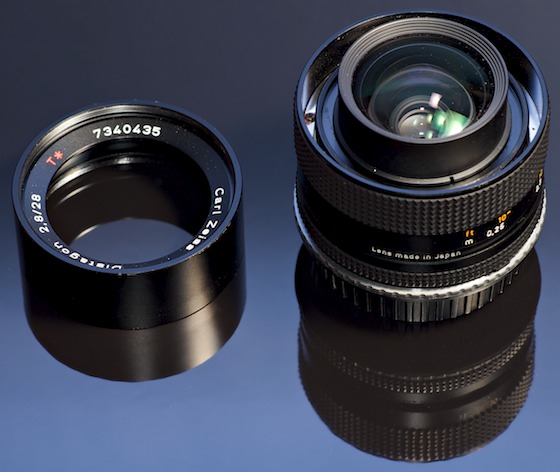
Notice! The adapter has to have correct thickness if lens has floating elements,
since by adjusting the moving lens group of such lens will introduce aperrations.
Pebble Place - C/Y adapters
|