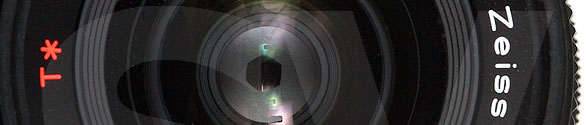
Carl Zeiss Distagon T* 2.8/28
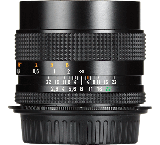
My usage
I mainly use this lens for landscapes and cityscapes. Sometimes I use this as a normal
wide angle lens in situations, in which corner sharpness isn't important.
Image quality
Sharpness and contrast
As can be seen from MTF graphs this lens is wicked sharp from center even wide open. However
corners eventually catch up at f/8 and f/11. In addition to sharpness the micro contrast
is excellent. When lens is used optimally pictures have very high acutance (apparent
sharpness).
At close range performance decreases, but in practice that has not been huge problem since
lens performance starts to decrease from 1 meter and it's not hopeless even in minimum focus
distance.
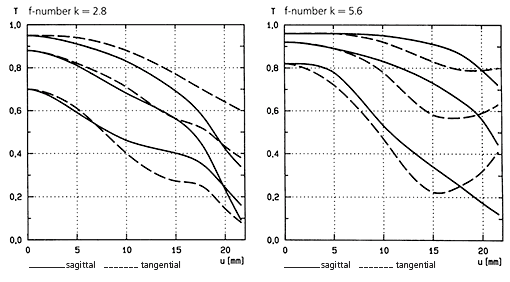
According to Zeiss (underline parts different than in Canon's MTFs): "The Modulation
Transfer (MTF) as a function of image height (u) and slit orientation (sagittal, tangential)
has been measured with white light at spatial frequencies of R = 10, 20 and 40
cycles/mm."
Highlight flare/reflection
Even people say that Carl Zeiss T* coating is the best coating available I have had some issues
with flare when photographing nighttime cityscapes. Below is example of this flare/reflection
problem. This might be caused by reflections between lens' back element and sensor?
However during daytime I have not seen problems even sun is shining directly to the lens. Even
in those situations veiling flare isn't problem.
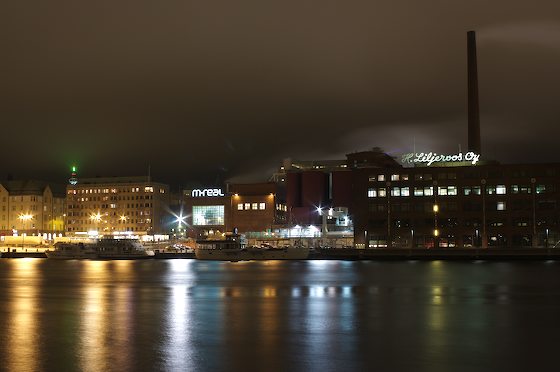
Whole image, from which below are crops which show the problems in more detailed way.
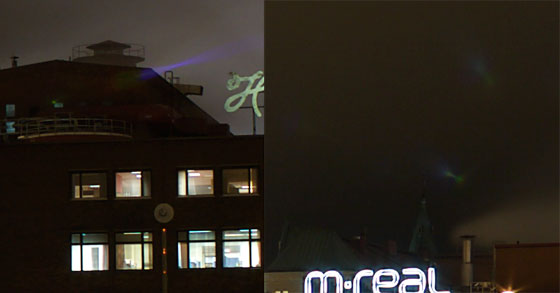
As you can see the highlights cause lens to flare and cause some sort of reflected highlight on opposite side of the image (compared to center point of the image).
Build quality and basics
Lens body is made of metal and there is no wobbling or anything else strange. Build quality
is excellent.
 Lens is very compact: Length 79mm (with C/Y adapter and lens caps, bare lens),
diameter 62mm and distance from EOS mount with adapter is 52mm (how much lens extends
from camera). Weight with C/Y adapter and lens caps is 311g, and the lens itself
weights 276g. Lenses minimum focusing distance is 0.25m. Lenses minimum aperture is
f/22. Lens has 6 aperture blades, and therefore aperture doesn't stay round when
closed down.
Lens is very compact: Length 79mm (with C/Y adapter and lens caps, bare lens),
diameter 62mm and distance from EOS mount with adapter is 52mm (how much lens extends
from camera). Weight with C/Y adapter and lens caps is 311g, and the lens itself
weights 276g. Lenses minimum focusing distance is 0.25m. Lenses minimum aperture is
f/22. Lens has 6 aperture blades, and therefore aperture doesn't stay round when
closed down.
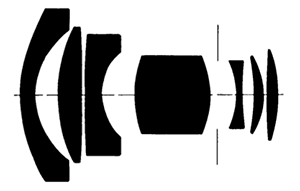
Lens has 7 elements which are in 7 groups. Actual focal length is 28.5mm. Minimum
focus distance is 0.25, which results 0.11x maximum magnification and full frame
(36mm x 24mm) coverage of 316mm x 211mm. Magnification is
calculated based on focal length and minimum focus distance.
Handling
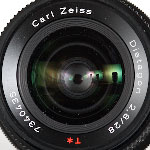 Manual focus feeling is very good, there is just about correct amount of resistance.
Focusing from minimum distance to maximum distance takes about 140 degrees.
Manual focus feeling is very good, there is just about correct amount of resistance.
Focusing from minimum distance to maximum distance takes about 140 degrees.
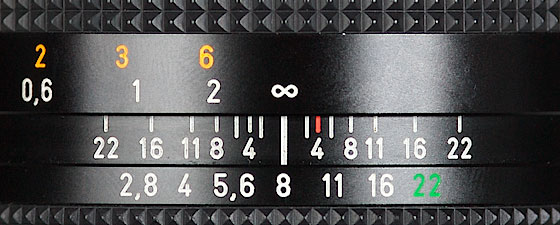
Lens also has proper depth of field scale. However on digital cameras I would
recommend atleast one stop higher value since the circle of confusion is smaller
these days when digital SLRs enable much larger print sizes than film cameras.
Summary
Pros
+ When closed down (f/8 and f/11) world class sharpness and accutance
+ Very compact size
+ Excellent build quality, while maintaining small weight
Cons
- Performance on close-ups (no floating element): sharpness decreases and some barrel
distortion appears
See photos
in my picturebank taken with this lens.
See how lens performs with 12mm extender:
Cactus with 12mm extension tubes - 1 of 2
Cactus with 12mm extension tubes - 2 of 2
digLloyd Zeiss ZF lenses
Zeiss.com - Carl Zeiss Distagon T* 35mm f/2.0
Zeiss.com - Carl Zeiss Makro-Planar T* 100mm f/2.0
16-9.net - Test of 28mm lenses including CZ 28/2.8
Pebble Place - Carl Zeiss Planar T* 2/100
Pebble Place - Carl Zeiss Macro-Sonnar T* 2.8/100 N
SLR Lens Review - Contax Sonnar T* 2.8/135mm C/Y
SLR Lens Review - Contax Sonnar T* 2.8/85mm C/Y
SLR Lens Review - Contax Planar T* 1.7/50mm C/Y
Pebble Place - Contax Sonnar T* 2.8/135mm C/Y
Some example pictures of Zeiss lenses
pinciuc.com - samples from various lenses
Pictures of lens
Extending while focusing
Distagon 28mm extends while focused close.
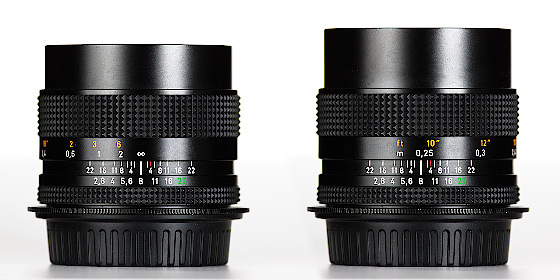
On the left side: Focused to infinity
On the right side: Focused to minimum focus distance
Depth of field scale
Distagon 28mm has pretty good depth of field scale. However on digital cameras I would
recommend one stop higher value since the circle of confusion is smaller these days when
digital SLRs enable much larger print sizes than film cameras.
Depth of field scale
|
