Carl Zeiss Makro-Planar T* 2/100 ZF
My usage
I use short tele lens as my main lens when I'm taking nature photographs. I use it to all
kind of purposes from close-ups to lanscapes. Typically in everything else than landscape
photography the foreground and background can not be sharp, therefore it's very important that
bokeh is good quality.
For actual macro shots I prefer to use Canon EF180mm f/3.5 L USM
since it offers more working distance and more magnification.
Image quality
2008-03-01: In order to give final verdict more photographs are needed to be taken. This
section is under construction.
Sharpness and Contrast
Based on photos I have taken I have no reason to doubt that the measured MTF charts would not
be as Zeiss has them measured. Performance is perfect even wide open with 1DmkIII. Also this
lens will keep delivering once I update to full frame camera, according to Lloyd
Chambers it resolves Nikon D3x 24.4Mpix sensor in extreme corner of frame at f/2
easily.
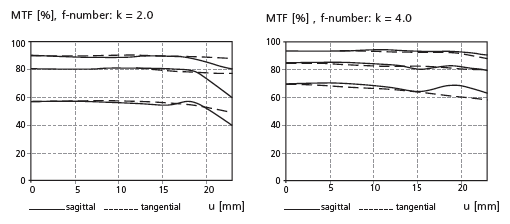
According to Zeiss (underline parts different than in Canon's MTFs): "The Modulation
Transfer (MTF) as a function of image height (u) and slit orientation (sagittal, tangential)
has been measured with white light at spatial frequencies of R = 10, 20 and 40 cycles/mm."
Bokeh
Generally bokeh is very "Zeiss"-like in this lens; smooth and lively at same time.
XXX highlight shapes - in corners "cateye" or not
XXX highlight shapes - is the highlight circle having strong edges or soft edges
Optically worst fault in this lens is LoCA (Longitudinal Chromatic Aberration) in bokeh. It's
not as bad as with Canon EF85L f/1.2 L USM mkII, but the magenta and greed fringes outside
focal plane may be very visible and impossible to remove. If you shoot subjects which have
tendency to produce LoCA (e.g. photographing cars with lot of chrome, which is in bokeh)
NOTICE! LoCA exists only in bokeh, not in focal plane!
Lens flare
This lens handles back light situations very well - I have no hesitations to shoot
at any conditions with this lens, I can have confidence that Makro-Planar delivers.
When I have taken night photos, in which strong light sources are in frame, I have not
seen any flaring. Practically this lens is flare free. Also I have not detected any sort
of veiling flare.
Vignetting and distortion
Wide open lens has pretty strong vignetting. It's less serious at high magnifications,
but it's pretty bad at infinity. However in practice landscapes are not shoot at f/2, but
this limits usage of the lens in some applications, for example photographing stars.
Vignetting in almost gone by f/4.
I have not been able to notice any distortion when shooting with the lens. This matches well
with the distortion graphs Zeiss has published.
Micro contrast
Textures etc.
Close ups/macro image quality
2008-03-01: not yet tested, have to wait until spring...
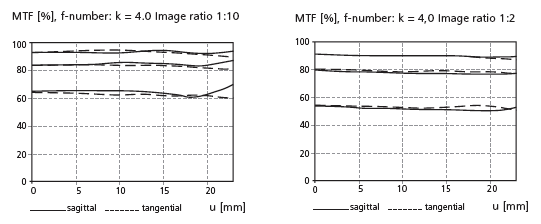
According to Zeiss (underline parts different than in
Canon's MTFs): "The Modulation Transfer (MTF) as a function of image height (u) and
slit orientation (sagittal, tangential) has been measured with white
light at spatial frequencies of R = 10, 20 and 40 cycles/mm."
Handling and usage
Focusing from infinity to 0.44 meter is about 360 degrees rotation. Manual focus feeling is
very tight and in some situations I would prefer to have less resistance when turning the
manual focus ring. Manual focusing is very accurate and it's very easy to achieve accurate
focus with live view. For Canon users the focus ring also turns into wrong direction; e.g.
all the way to clockwise is infinity and not minimum focus distance
Aperture is can be selected 1/2 stop intervals. When using viewfinder and manually stopping
down it's easy to calculate "clicks" from wide open to determinen the aperture into which
lens is stopped down. Only problem with setting aperture is that the lens barrel is quite
wide (wider than aperture ring) and aperture ring is between lens barrel and camera and in
some situations it wasn't easy to adjust aperture, specially with gloves.
Lens hood protects front lens element very well physically and quite well from sun and other
light sources which could cause flares or decreased contrast if allowed to shine to front
lens element. Zeiss lens caps are not very good to operate and I have replaced them with
Nikon lens caps with have better design.
Polarizer is quite difficult to operate when hood is attached to lens. Hood protects filter
quite well from sun and other light sources. However when filter is used 1/3 of it's exposed
to lights source if light is coming from angle that it barely reaches outer 1mm from the front
lens element.
Build quality and basics
Build quality is as good as I could imagine, from different planet than Canon lenses.
Lens hood has bajonet and lens hood is made of metal, not plastic. Lens hood fits very well
to lens and can be reversed.
 Lens dimensions with Nikon to EOS adapter and lens caps are: diameter 76mm, length 116mm,
weight 720g. Dimensions when including hood: diameter 82mm, length 162mm and weight 780g.
Length from EOS lens mount with hood is between 145mm and 199mm. This lens isn't internal
focusing and therefore extends when focused closer. Lens extends about 44mm when focused
to minimum focus distance 0.44m. Lens uses weird filter size of 67mm, I don't use any
other filter than Circular Polarizers and I didn't even have this size yet.
Lens dimensions with Nikon to EOS adapter and lens caps are: diameter 76mm, length 116mm,
weight 720g. Dimensions when including hood: diameter 82mm, length 162mm and weight 780g.
Length from EOS lens mount with hood is between 145mm and 199mm. This lens isn't internal
focusing and therefore extends when focused closer. Lens extends about 44mm when focused
to minimum focus distance 0.44m. Lens uses weird filter size of 67mm, I don't use any
other filter than Circular Polarizers and I didn't even have this size yet.
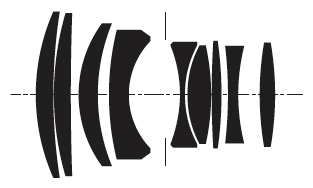
Minimum aperture is f/22. Aperture has 9 blades and aperture remains very round even at
f/22. Lens has 9 elements which are in 8 groups. Actual focal length is 97.5mm. Minimum
focus distance is 0.44m, which results 1:2 magnification and full frame (36mm x 24mm) coverage of 72mm x 48mm. On 1.3x crop camera coverage is 55mm x 37mm
and in 1.6x crop 45mm x 30mm.
Summary
Pros
+ Sharpness, microcontrast, contrast and colors are excellent
+ Stopping down is needed only to increase depth of field, contrast increases a little
bit at f/2.8, but starts to decrease at f/5.6-8 depending pixel size of camera
+ Build quality and all metal construction
+ Lens performs very well in backlight situations
Cons
- Aperture ring is not easiest to use since it's between camera body and wide lens barrel
- Lens extends when focused
-
-
See photos
in my picturebank taken with this lens.
digLloyd Zeiss ZF lenses
Zeiss.com - Carl Zeiss Distagon T* 35mm f/2.0
Zeiss.com - Carl Zeiss Makro-Planar T* 100mm f/2.0
16-9.net - Test of 28mm lenses including CZ 28/2.8
Pebble Place - Carl Zeiss Planar T* 2/100
Pebble Place - Carl Zeiss Macro-Sonnar T* 2.8/100 N
SLR Lens Review - Contax Sonnar T* 2.8/135mm C/Y
SLR Lens Review - Contax Sonnar T* 2.8/85mm C/Y
SLR Lens Review - Contax Planar T* 1.7/50mm C/Y
Pebble Place - Contax Sonnar T* 2.8/135mm C/Y
Some example pictures of Zeiss lenses
pinciuc.com - samples from various lenses
Pictures of Carl Zeiss Makro-Planar T* 2/100 ZF
Lens extends when focused
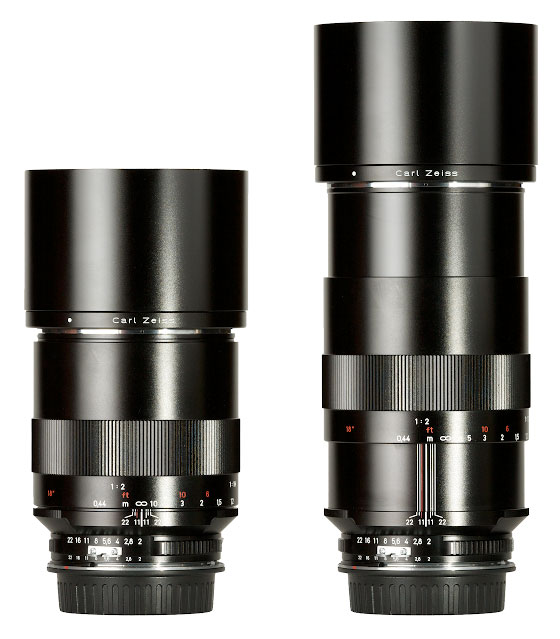
Distance from EOS lens mount (including adapter) to end of the hood is 145mm at infinity and
199mm at 1:2.
Front/side projection
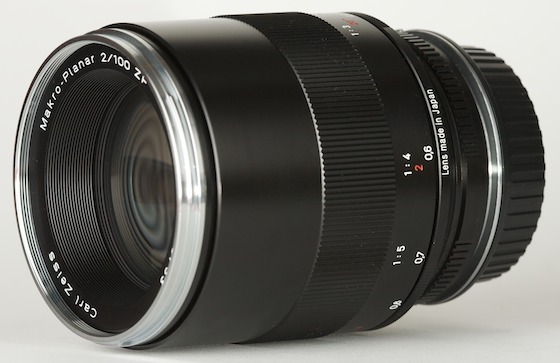
Made in Japan, unfortunately...
Aperture ring in tight place
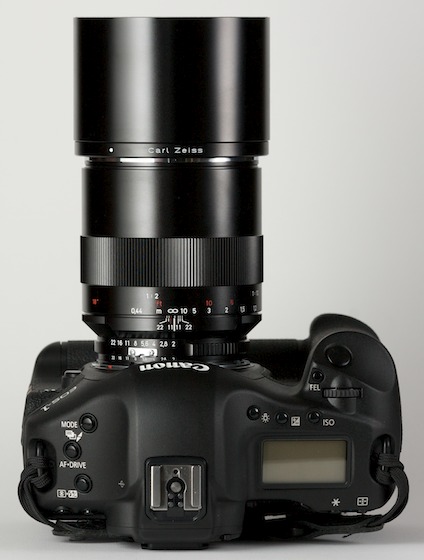
As you can see from photo aperture ring is not easiest to access, at least with gloves on
freezing temperatures.
|
